Launch offer — valid today only

The Private Pilot Knowledge Test, One Illustrated Page per Topic With Every Topic Drawn Step by Step!

The four forces, pitot-static, airspace, METARs, density altitude, weight and balance, VORs and the rules. One topic per page: the drawing, and a box with what you need to remember. 67 illustrated pages.

I WANT THE ILLUSTRATED BOOK

🔒 Secure checkout · PDF by email · 30-day guarantee

One topic per pageOne topic per page, every concept drawn
67 illustrated pages7 parts, from the four forces to test day
Up-to-date sourcesFAA Private Pilot ACS, PHAK and 14 CFR Parts 61 and 91

This Is What the Pages You Will Study Look Like

One topic per page, the drawing that shows you how it works and the boxes with what you need to know:

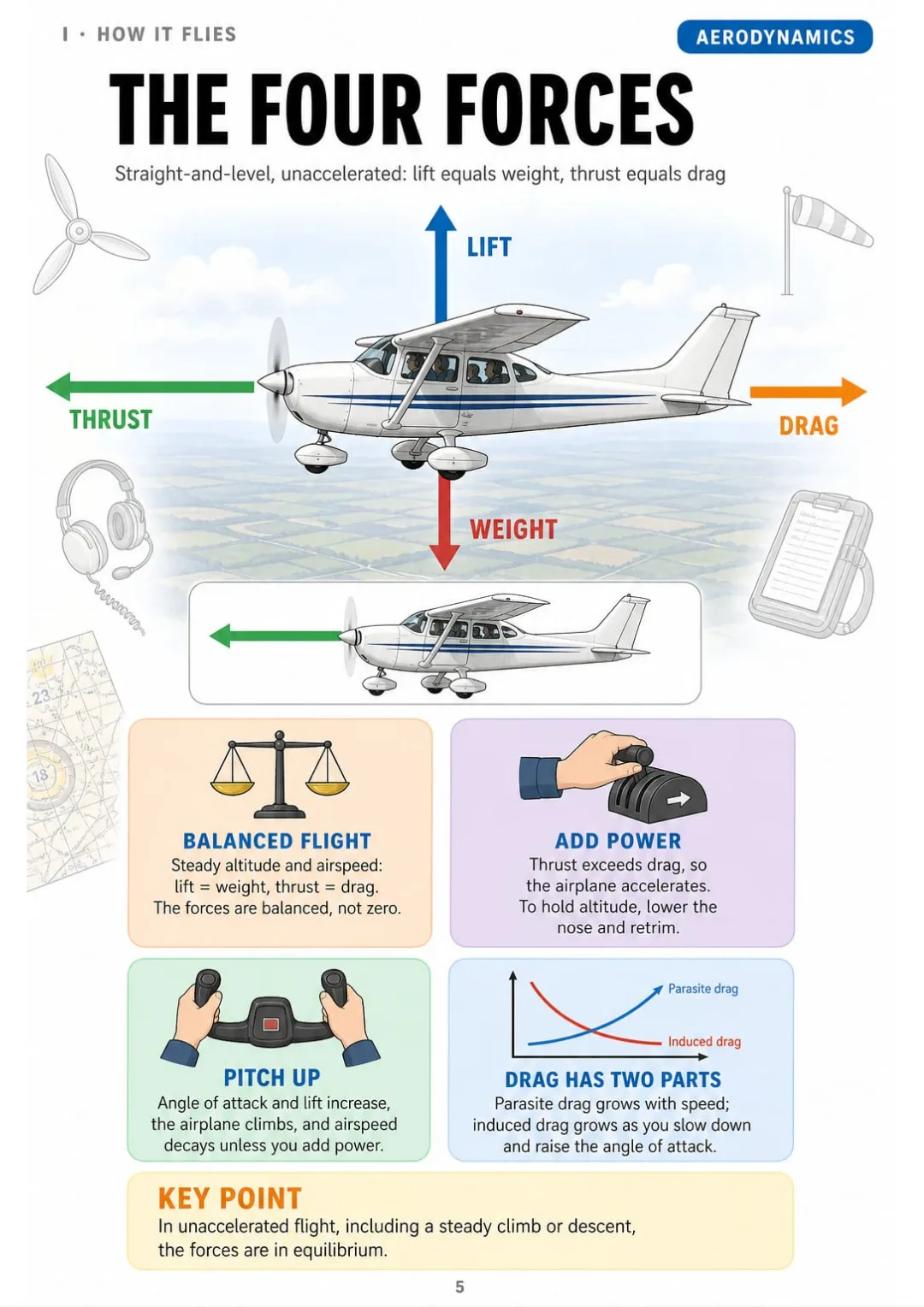
Straight-and-level, unaccelerated flight: lift = weight and thrust = drag.
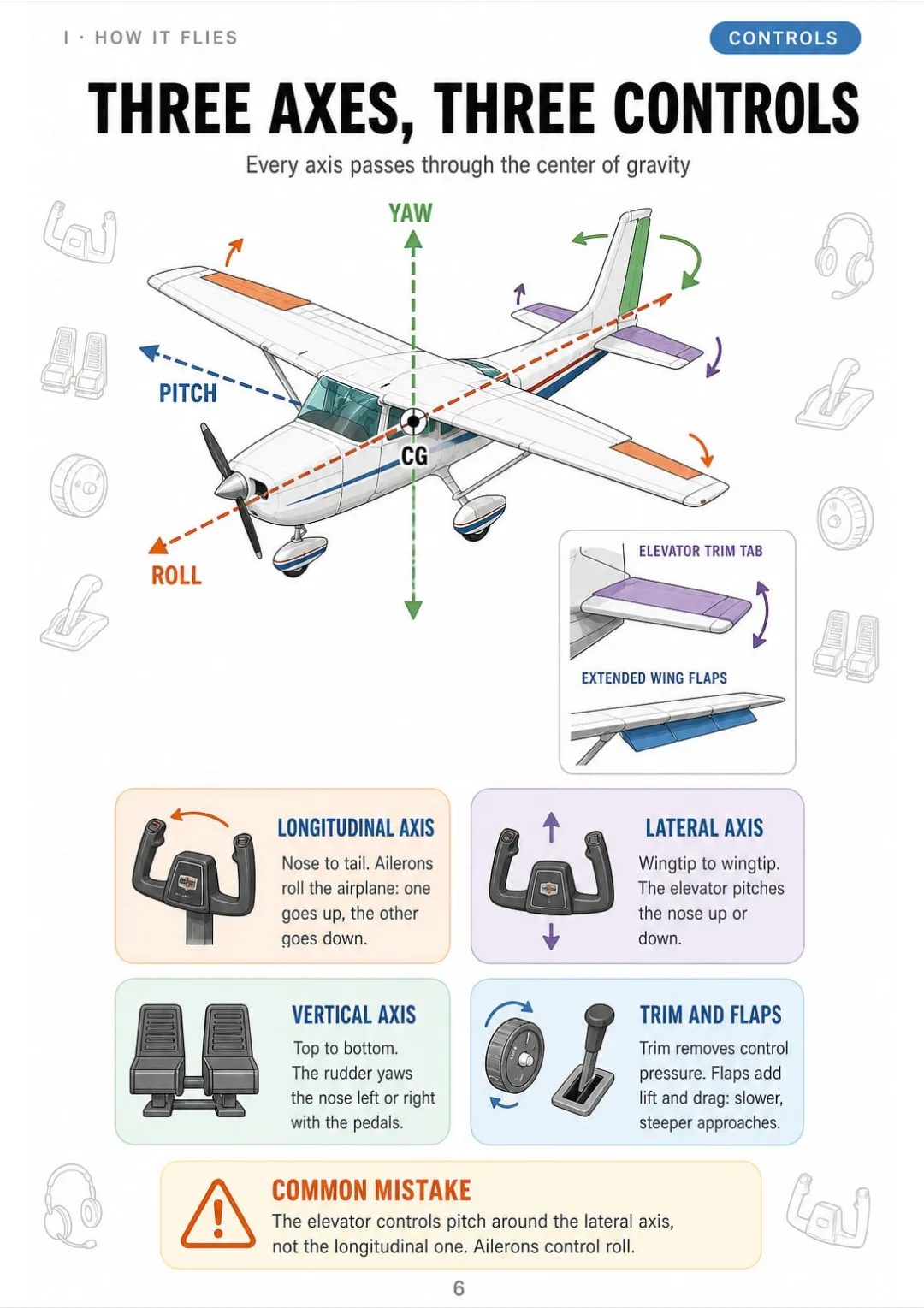
Roll = ailerons, pitch = elevator, yaw = rudder, all around the CG.
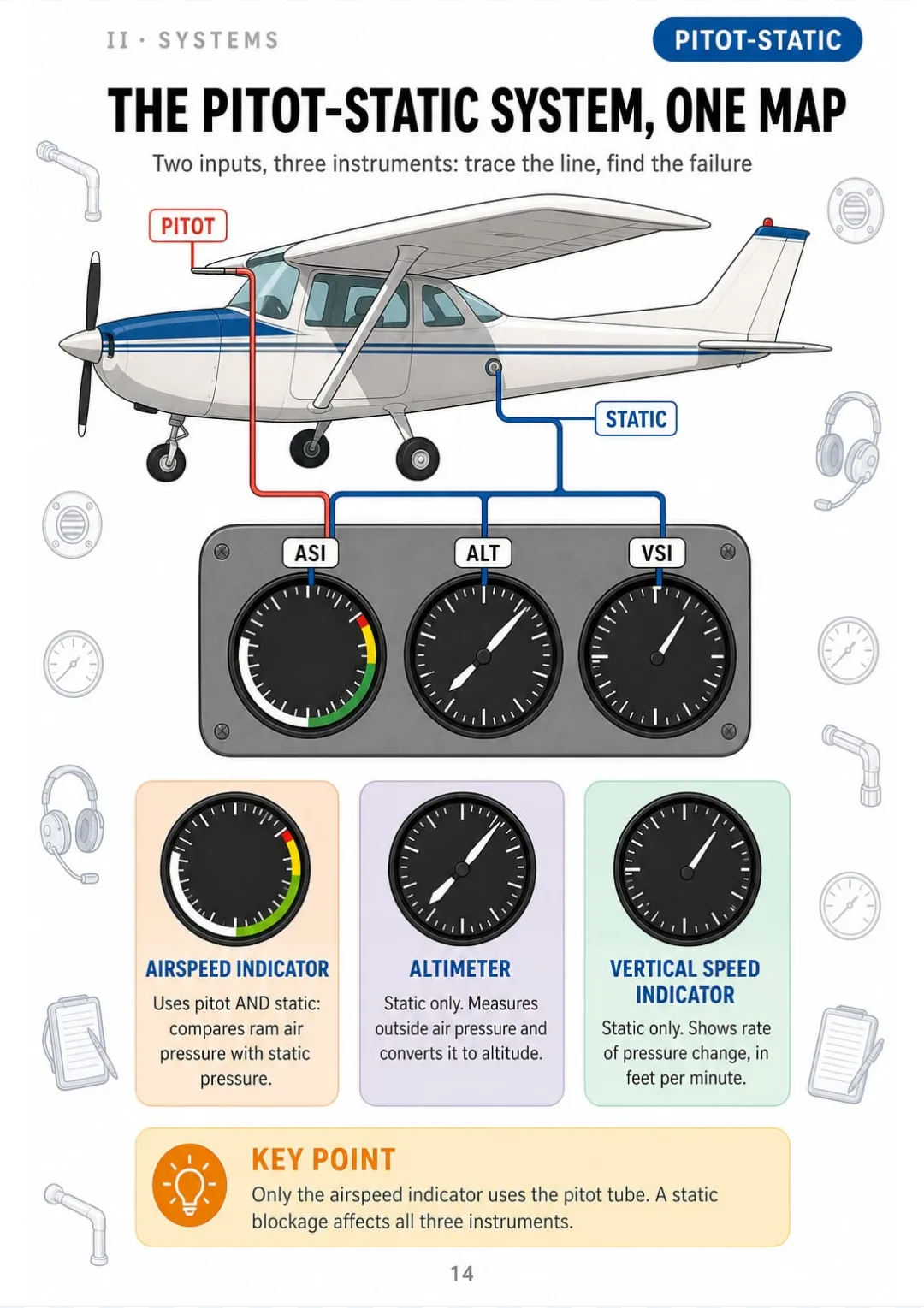
Pitot feeds only the airspeed indicator; static feeds all three instruments.
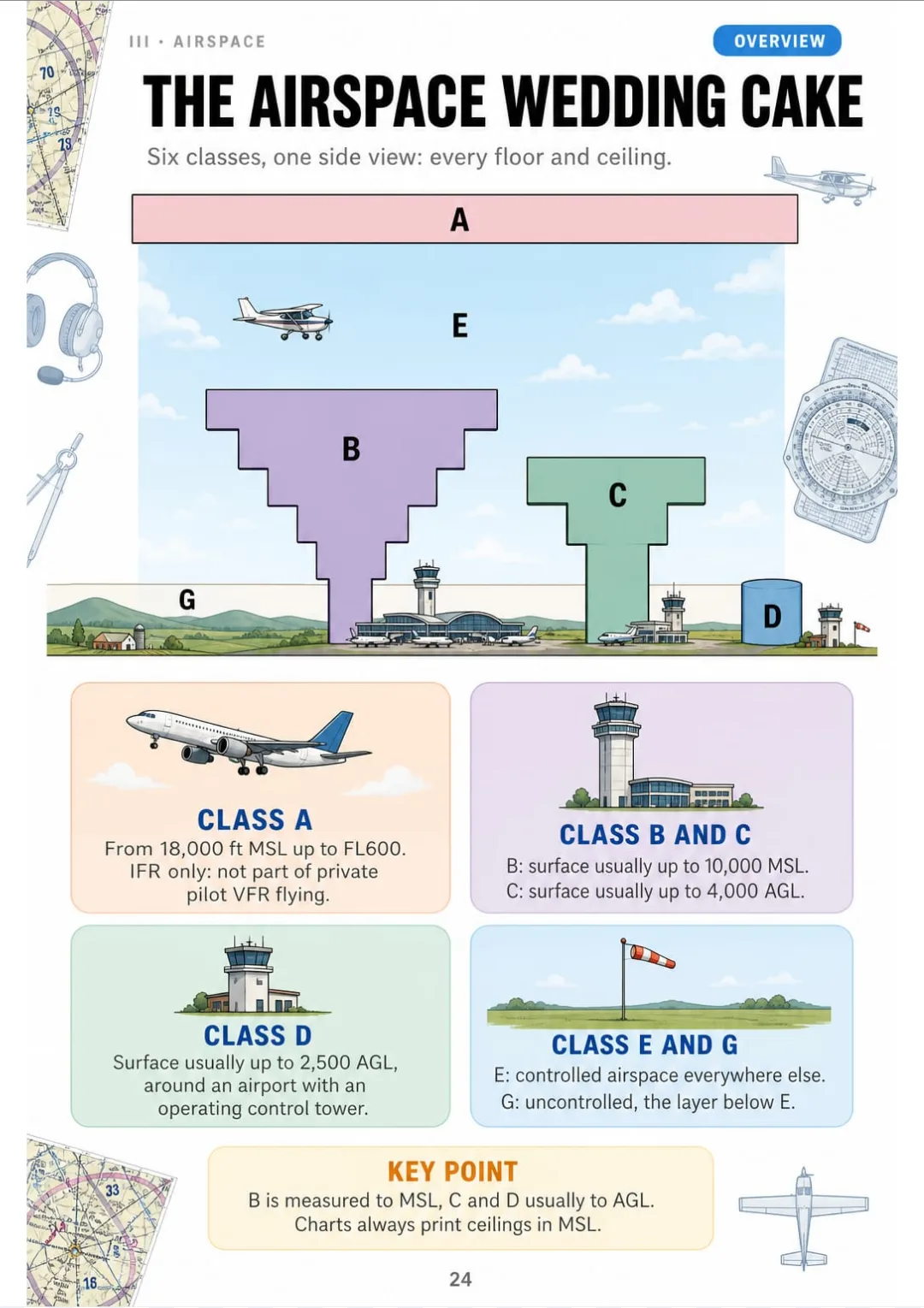
A 18,000 MSL–FL600 · B ~10,000 MSL · C ~4,000 AGL · D ~2,500 AGL · E and G below
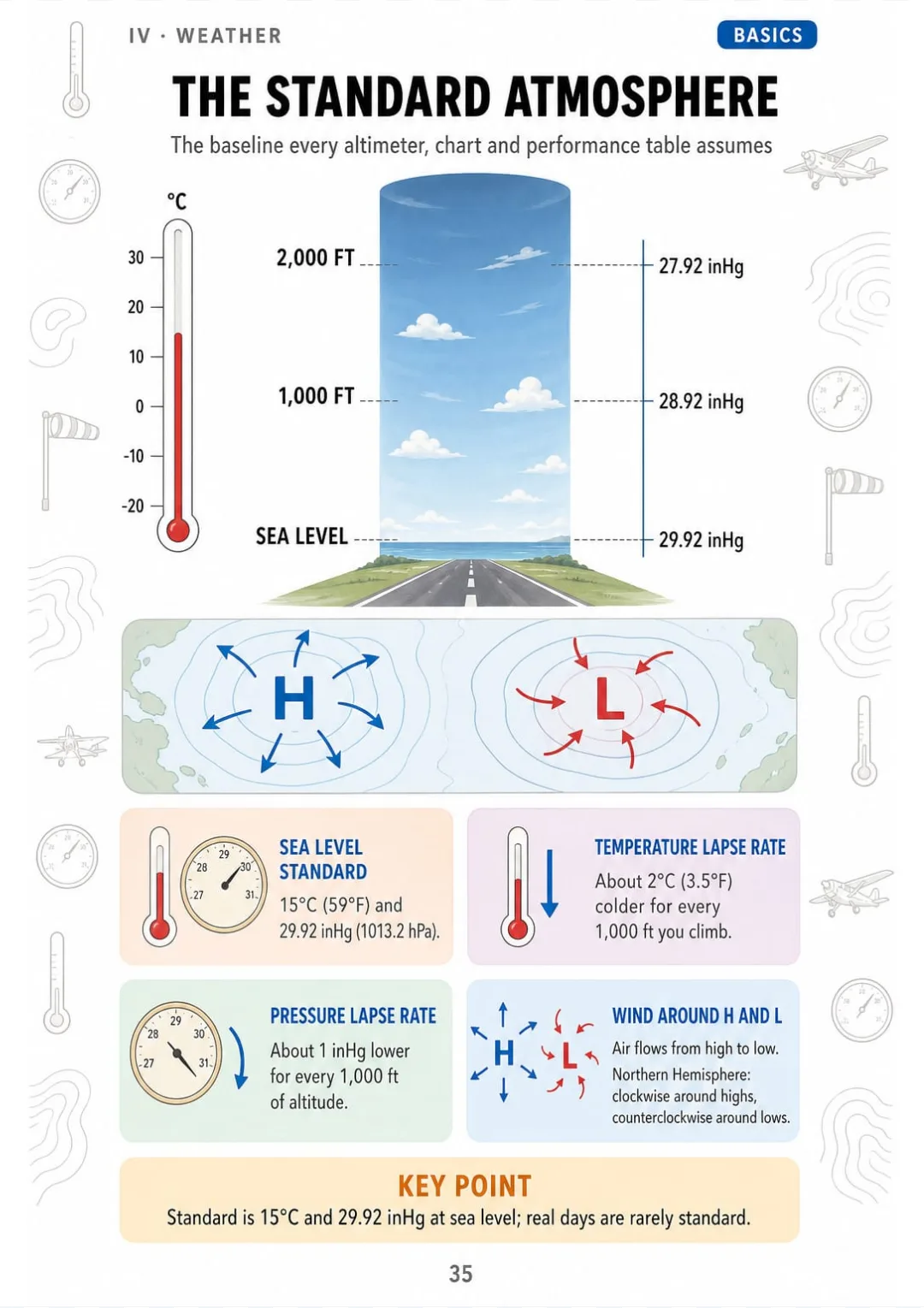
Sea level standard: 15°C, 29.92 inHg; minus 2°C and 1 inHg per 1,000 ft.
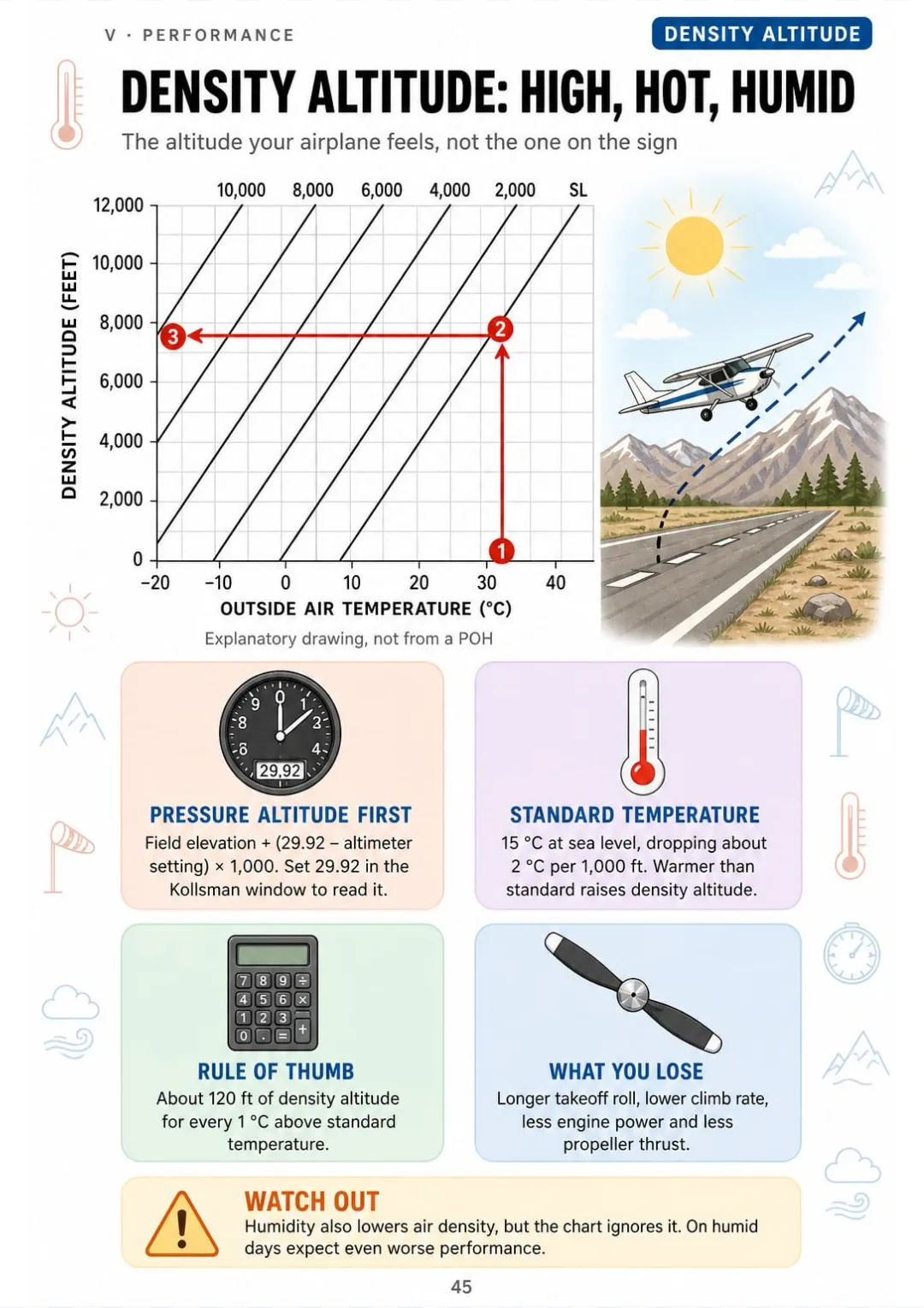
Density altitude = pressure altitude corrected for nonstandard temperature, read in 3 moves
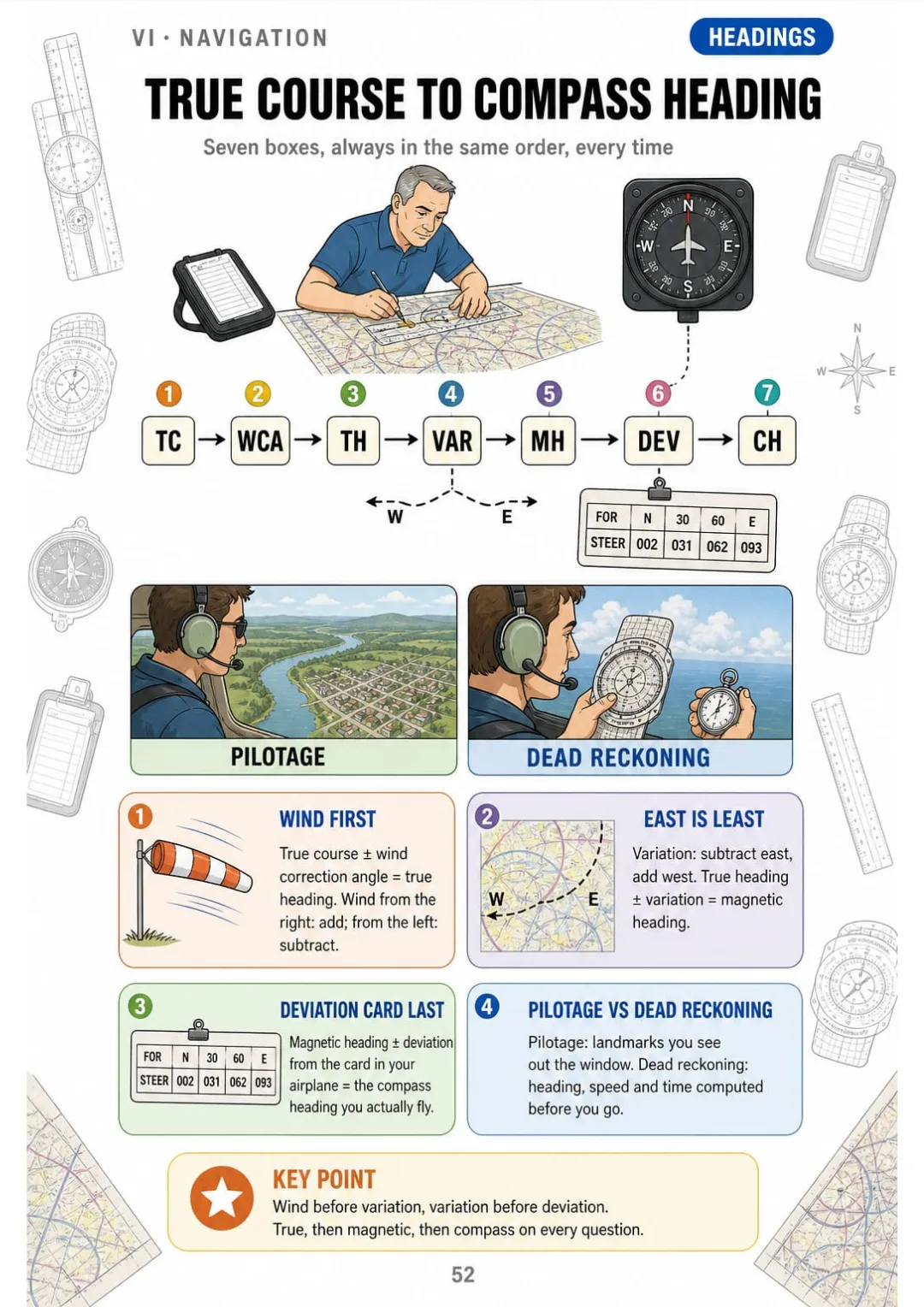
TC → WCA → TH → VAR → MH → DEV → CH: subtract east, add west.
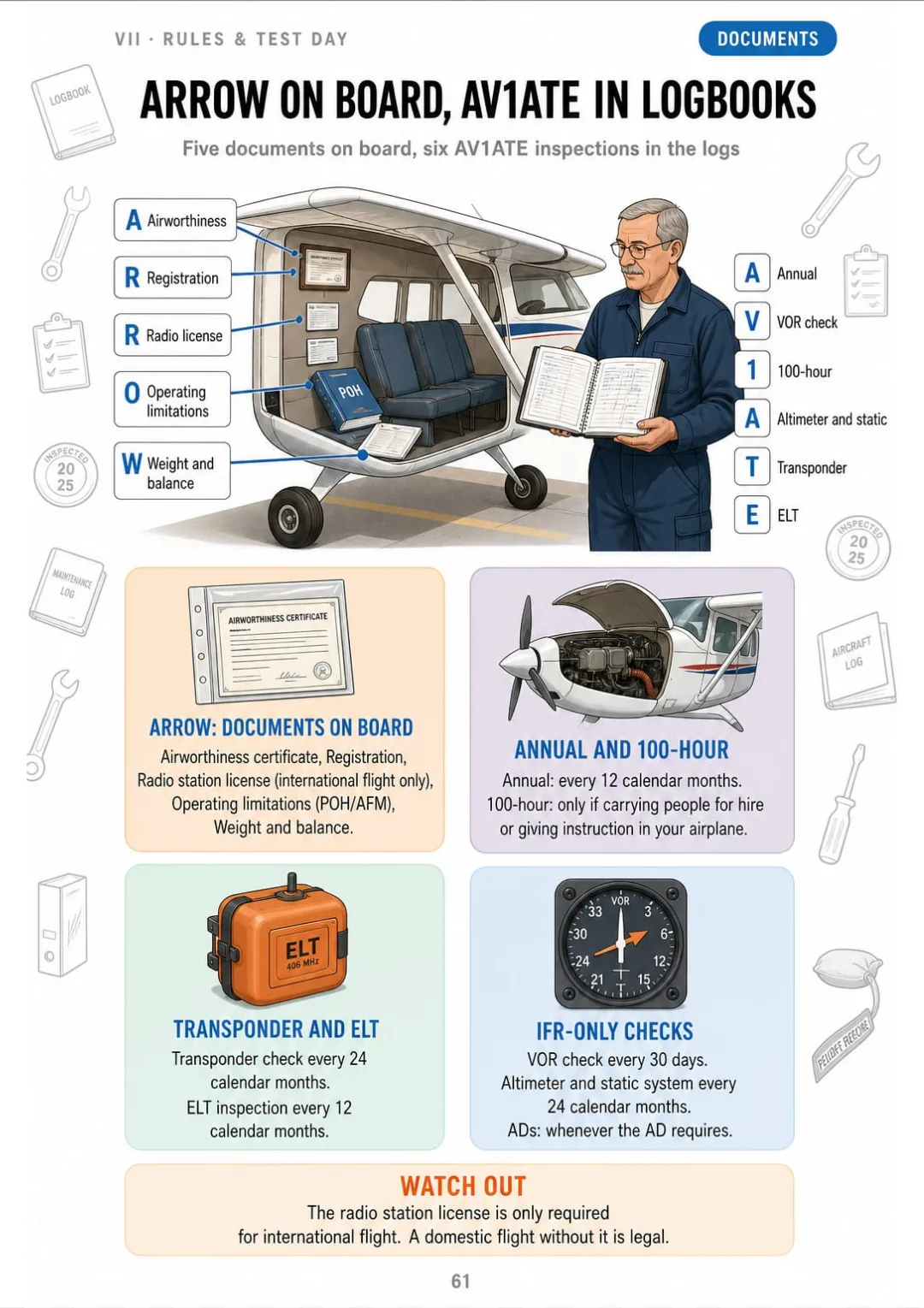
ARROW for documents, AV1ATE for inspections: annual 12 months, transponder 24, ELT 12.

Swipe to see more →

These are real pages from the book. The table of contents is the full one: 7 parts and 63 topics.

It's Not That You Have a Bad Memory. It's That No One Put It in Order for You.

You've read the pitot-static chapter three times. You close the handbook...

...and you can't remember which instruments go wrong when the static port is blocked. It was just one line after another.

Pitot feeds only the airspeed indicator; static feeds all three instruments.

Here the pitot-static system is one map: the pitot tube feeding only the airspeed indicator, the static port feeding all three, and what each instrument shows when a line is blocked.

And on the pages next to it, every system gets its own: the altimeter, the gyros, the magnetic compass, the engine and carburetor icing.

First you understand why it works that way. Then the order sticks on its own.

SEE THE DIFFERENCE

Stop memorizing rules you can't picture:

THIS
  • Pages and pages of dense text
  • Systems and charts without a single drawing
  • On the test, you don't know where to start
The airplane is free to rotate about three axes, all of which pass through the center of gravity. Movement about the longitudinal axis is termed roll and is controlled by the ailerons, which deflect in opposite directions and thereby alter the lift produced by each wing. Movement about the lateral axis, termed pitch, is governed by the elevator or stabilator, while movement about the vertical axis, termed yaw, is governed by the rudder, which also counteracts the adverse yaw generated by aileron deflection.
FOR THIS
  • Every concept drawn
  • One topic per page, with the rules in boxes
  • You remember it because you've seen it
Roll = ailerons, pitch = elevator, yaw = rudder, all around the CG.
CONTENTS

Take a Look at the 7 Parts and 63 Topics

How an airplane flies, systems and instruments, airspace and the sectional, weather, performance and weight and balance, navigation and airport operations, and rules, pilot factors and test day: 67 pages, all illustrated

IHow an Airplane Flies · pp. 5-13
  1. The Four Forces
  2. Three Axes, Three Controls
  3. Angle of Attack and the Stall
  4. Load Factor in Turns
  5. Left-Turning Tendencies
  6. Stability and Where the CG Sits
  7. Ground Effect
  8. Wake Turbulence
  9. Part I Review
IISystems and Instruments · pp. 14-23
  1. The Pitot-Static System, One Map
  2. Blocked Pitot, Blocked Static
  3. Airspeed Indicator Color Arcs
  4. The Altimeter and the Five Altitudes
  5. Gyroscopic Instruments
  6. Magnetic Compass Errors
  7. Engine and Ignition
  8. Fuel, Mixture and Detonation
  9. Carburetor Icing
  10. Part II Review
IIIAirspace and the Sectional Chart · pp. 24-34
  1. The Airspace Wedding Cake
  2. Class B
  3. Class C
  4. Class D
  5. Class E and Class G
  6. VFR Weather Minimums, One Table
  7. Special Use Airspace and TFRs
  8. Airport Symbols and Data Blocks
  9. Obstructions, MEF and Lat/Long
  10. Method: Read Any Point on the Sectional in 5 Steps
  11. Part III Review
IVWeather and Weather Services · pp. 35-44
  1. The Standard Atmosphere
  2. Stability, Dew Point and Clouds
  3. Fronts
  4. Thunderstorms and Wind Shear
  5. Fog and Icing
  6. Method: Decode a METAR in Order
  7. Reading a TAF
  8. Winds and Temperatures Aloft (FB)
  9. GFA, AIRMET, SIGMET and PIREP
  10. Part IV Review
VPerformance, Weight and Balance · pp. 45-51
  1. Density Altitude: High, Hot, Humid
  2. Method: Takeoff and Landing Distance Charts
  3. Crosswind Component Chart
  4. Weight, Arm and Moment
  5. Method: Calculate the CG in 4 Steps
  6. Shifting Weight and Burning Fuel
  7. Part V Review
VINavigation and Airport Operations · pp. 52-60
  1. From True Course to Compass Heading
  2. Time, Speed, Distance and Fuel
  3. Reading a VOR
  4. Runway Markings
  5. Airport Signs
  6. Traffic Pattern and Segmented Circle
  7. Airport Lighting: Beacon, VASI and PAPI
  8. Radio, Transponder and Light Gun Signals
  9. Part VI Review
VIIRules, Pilot Factors and Test Day · pp. 61-67
  1. Documents and Inspections
  2. Pilot Currency, Medical and Privileges
  3. Right-of-Way, Altitudes and Fuel
  4. Aeromedical Factors
  5. Decision-Making and Hazardous Attitudes
  6. Frequent Mix-Ups, Side by Side
  7. Test Day Checklist

What If Every Topic Fit on a Single Page?

What if every topic fit on a single page?

Instead of rereading half a page about density altitude without being able to see it...

...you open the page and find high, hot and humid drawn side by side, with the three moves that take you from pressure altitude to density altitude.

Sea level standard: 15°C, 29.92 inHg; minus 2°C and 1 inHg per 1,000 ft.

And the pitot-static system, the airspace classes, METARs, weight and balance and the VOR become drawings and tables you can read at a glance.

You stop memorizing and start understanding.

That's Private Pilot Made Visual: 67 illustrated pages in 7 parts, 57 topics, a review page closing Parts I to VI and a test day checklist at the end. What you see in order, you remember.

Because what your brain sees organized, it remembers.

Here Is What You Get with Private Pilot Made Visual:

Ipp. 5-13

How an Airplane Flies

The four forces, the three axes and controls, angle of attack and the stall, load factor, left-turning tendencies, stability, ground effect and wake turbulence.

IIpp. 14-23

Systems and Instruments

The pitot-static system on one map, blocked pitot and static, airspeed color arcs, the five altitudes, gyros, compass errors, engine, fuel, mixture and carburetor icing.

IIIpp. 24-34

Airspace and the Sectional Chart

The airspace wedding cake, Classes B, C, D, E and G, VFR weather minimums in one table, special use airspace and TFRs, sectional symbols and a 5-step method to read any point.

IVpp. 35-44

Weather and Weather Services

The standard atmosphere, stability and clouds, fronts, thunderstorms, fog and icing, a METAR decoded in order, the TAF, winds aloft, GFA, AIRMET, SIGMET and PIREP.

Vpp. 45-51

Performance, Weight and Balance

Density altitude, takeoff and landing distance charts, the crosswind chart, weight, arm and moment, the CG in 4 steps, and shifting weight and burning fuel.

VIpp. 52-60

Navigation and Airport Operations

True course to compass heading, time, speed, distance and fuel, the VOR, runway markings and signs, the traffic pattern, airport lighting, radio, transponder and light gun signals.

VIIpp. 61-67

Rules, Pilot Factors and Test Day

Documents and inspections, currency, medical and privileges, right-of-way and altitudes, aeromedical factors, decision-making, frequent mix-ups side by side and the test day checklist.

At the end of the book: A review page closing Parts I to VI, and a test day checklist on the last page.


And That Is Not All: 2 More Books, Free

Sectional Chart & METAR Drills

BONUS 1: «Sectional Chart & METAR Drills»

Value on its own: US$ 17.90

Practice reading airspace, symbols, METARs and TAFs on redrawn chart excerpts, with every answer worked out in the same steps as the book.

Common PAR Mix-Ups & Test Day Checklist

BONUS 2: «Common PAR Mix-Ups & Test Day Checklist»

Value on its own: US$ 14.90

The mix-ups students make most often (VFR minimums, right-of-way, density altitude) on quick-review cards, plus what you need for test day: CFI endorsement, registration and what to bring.

Private Pilot Made Visual + 2 Free Books

  • Private Pilot Made Visual: 67 illustrated pagesUS$ 63
  • BONUS 1: Sectional Chart & METAR DrillsUS$ 17.90
  • BONUS 2: Common PAR Mix-Ups & Test Day ChecklistUS$ 14.90
  • High-resolution PDF to printIncluded
Total value US$ 95.80
YOUR PRICE:
US$ 27
You save US$ 68.80
YES, I WANT PRIVATE PILOT MADE VISUAL FOR US$ 27

📄 This is a digital PDF book sent to your email: nothing is printed or shipped.

Secure purchaseEncrypted payment30-day guarantee

PDF by email: Private Pilot Made Visual reaches your inbox as a PDF, and the two free books come by email too. One-time payment, no installments or hidden costs.

Is This Book for You?

You're working toward your Private Pilot certificate

You're working toward your Private Pilot certificate

Aerodynamics, systems, airspace and weather, one topic per page, to review at night between lessons with your CFI.

Your knowledge test is coming up

Your knowledge test is coming up

A review of every area of the test, with a fixed method for the sectional, the METAR, performance charts and the CG, and review pages at the end of each part.

Your checkride is next

Your checkride is next

A quick visual review before the oral: airspace, VFR minimums, documents and inspections, all on pages you can print and take to the airport.

To Sum Up: Here Is What You Get

US$ 95.80US$ 27
YES, I WANT PRIVATE PILOT MADE VISUAL FOR US$ 27

📄 This is a digital PDF book sent to your email: nothing is printed or shipped.

30DAYS
GUARANTEE

30-Day Guarantee

30-day guarantee: tell us what didn't work and we'll refund 100%.

You have 30 days to try Private Pilot Made Visual and the two bonus books. If it's not right for you, tell us what didn't work and we'll refund 100% of what you paid. One-time payment, no subscription, no surprises.

Frequently Asked Questions

Is it a PDF or a printed book, and how do I get it?

It's a PDF. After your purchase you get an email, at the address you enter at checkout, with Private Pilot Made Visual as a high-resolution PDF, to read on your phone or tablet or to print. The two bonus books, Sectional Chart & METAR Drills and Common PAR Mix-Ups & Test Day Checklist, come by email too.

Is it a monthly payment or a one-time payment?

One-time payment. No installments, no subscription.

Who is it for?

For anyone preparing for the FAA Private Pilot – Airplane knowledge test (PAR), whether you're starting ground school, already flying with a CFI or coming from Part 107. It doesn't replace the PHAK or your question app: it's the page you open before them. The PHAK explains in paragraphs and the app tells you when you got it wrong. Here each topic is one drawing with a fixed method, so you see why. Check the table of contents above to see every topic.

What sources is it based on?

It's based on the current FAA Private Pilot – Airplane Airman Certification Standards (FAA-S-ACS-6), the Pilot's Handbook of Aeronautical Knowledge (FAA-H-8083-25), the AIM, 14 CFR Parts 61 and 91, and the Airman Knowledge Testing Supplement (FAA-CT-8080-2). Chart and performance figures are redrawn to explain them, not copied. On test day you'll work with the official supplement, so download it free from faa.gov and keep it next to the book: the steps you learn here are the same ones you'll use on those figures.

Is this official FAA material?

No. It's an independent study book. It is not affiliated with or endorsed by the FAA or PSI, and the redrawn charts are labeled "Not for navigation."

Does it replace ground school or my CFI?

No. It's a visual study and review aid. It doesn't replace ground school, flight training, your CFI's endorsement or the official FAA publications. The aeromedical pages cover test content, not medical advice, and don't replace your AME.

Are the practice questions the ones on the real test?

No. They're written for this book to help you train on each topic, with the explanation and the page where it's drawn. They are not official test questions.

Can I print it?

Yes. Print the whole book or only the pages you need, and take them to the airport or keep them in your flight bag.

What if I don't like it?

30-day guarantee: tell us what didn't work and we'll refund 100%.

One Last Thing Before You Decide...

You don't have to reread the same page hoping it sticks this time.

You don't have to memorize airspace rules and systems you can't picture.

And you definitely don't have to walk into the test not knowing where to start.

One last thing before you decide: the handbook isn't the problem. The order is. Open the page, see the drawing, and study tonight with the order already laid out for you.

One-time payment: US$ 27 · Guarantee: 30 days · PDF by email

YES, I WANT PRIVATE PILOT MADE VISUAL FOR US$ 27

📄 This is a digital PDF book sent to your email: nothing is printed or shipped.